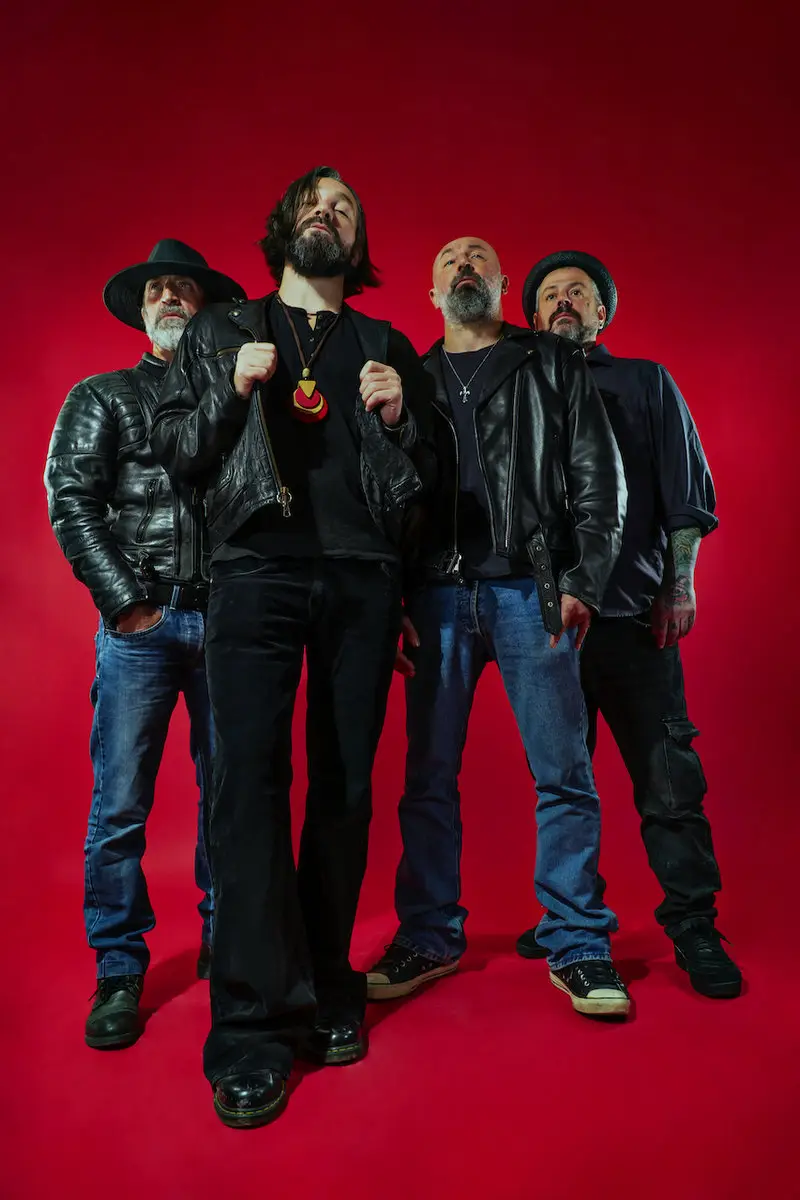
Momo de DI’AUL nos cuenta sobre su nuevo disco, EvAAvE , sobre el doom y sobre la música en general.
-Gracias Momo por la entrevista y enhorabuena por el álbum. En primer lugar, ¿cómo estás?
Hola, muchas gracias. Todo bien y estamos muy contentos con la gran acogida que está teniendo nuestro álbum. Hemos trabajado mucho en él y es una verdadera satisfacción ver que la gente lo disfruta.
-Hablemos de EvAAvE, presentadnos vuestro nuevo álbum.
El tema central del álbum gira en torno al aspecto femenino, entendido como algo que va más allá del género, una fuerza que existe dentro de todos nosotros. Sin embargo, debido a la educación, la moral o las normas sociales, a menudo lo reprimimos porque nos enseñan que es un signo de debilidad. En realidad, lo «femenino» es la parte más vital de cada uno de nosotros, que encarna lo que García Lorca llamó Duende (que es también el título de la canción de apertura), esa «fuerza misteriosa que irradia del espíritu de la Tierra, algo que se puede sentir pero no explicar».
Las letras exploran diferentes temas y situaciones a las que todos nos enfrentamos a diario, a menudo no de la manera que nos gustaría. Demasiado a menudo, actuamos y reaccionamos basándonos en convenciones dictadas por la sociedad, que las considera la manera «correcta». Pero, ¿y si no son adecuadas para nosotros? Ignorar las propias emociones en lugar de seguir el instinto no es más que hipocresía.
Por ejemplo, en Duende, la canción se adentra en una confrontación con la familia que debería haberse producido hace tiempo, buscando la redención a través de la memoria, al tiempo que se acepta la imposibilidad de la resolución, ya que el tiempo y las personas han seguido adelante.

-¿Por qué decidisteis grabar en analógico imitando la calidad de una actuación en directo?
Ya habíamos optado por este método de grabación con Abracamacabra, pero esta vez decidimos ir más allá, no sólo grabando el álbum en directo, sino también evitando cualquier tipo de edición. Nuestro objetivo era mantener el sonido lo más natural posible. Nuestra pasión por el sonido y el ambiente de los 70 nos llevó a tomar esta decisión, y tanto Enrico Baraldi como Esben Willems hicieron un trabajo increíble.
Es una decisión arriesgada porque hoy en día todos estamos acostumbrados a escuchar producciones impecables y pulidas. Así que, al abordar un álbum con un aire «vintage», siempre existe el riesgo de que la gente no capte del todo su esencia. Por eso apreciamos profundamente a grupos como Electric Wizard, que desde los años 90 han ignorado por completo los estándares de la industria y han seguido creando sonidos cada vez más cercanos al infierno.
-¿Qué hay dentro de la condición humana que le interesa tanto para sus letras?
Los altibajos de la vida moldean inevitablemente quiénes somos y cómo percibimos las cosas, aunque sólo sea durante un breve periodo de tiempo. Luego, hay acontecimientos tan impactantes que, nos guste o no, alteran nuestra expresión artística, manifestándose a través de sonidos y palabras diferentes, a veces más pesados y lentos, otras más rápidos y agudos.
A lo largo de los años, todos hemos cambiado algo de lo que somos plenamente conscientes, pero también creemos que hemos elegido un camino de crecimiento personal y musical. Para las letras de EvAAvE, nos inspiramos especialmente en la poesía de Sylvia Plath y Amelia Rosselli, aunque también hay referencias a Dylan Thomas y Emanuel Carnevali. La razón de esta elección reside en el hecho de que, especialmente en la obra de Plath, estas escritoras tenían la capacidad de narrar la lucha cotidiana con la familia y la sociedad de una manera a la vez sencilla y profunda, nunca trivial.
-¿Qué te gustaría que sintieran sus fans cuando escuchen el álbum?
Aunque sé que puede ser una opinión impopular, creo que la música doom es un poco como el blues, es un género que te da libertad absoluta para tocar dentro de una especie de cliché o estándar. Al final, el blues, al igual que el doom, puede parecer repetitivo, pero en realidad siempre es diferente.
El aspecto más fascinante es el propio tiempo: en un mundo que se mueve a gran velocidad, tocar despacio, reflexionando sobre los sonidos y las palabras, ésa es la auténtica revolución.
Como muchos grupos, nos inspiramos en los padres fundadores, Black Sabbath, Sir Lord Baltimore, Atomic Rooster, pero también nos influyen otros 50 años de música, sobre todo los 90, que tuvieron un gran impacto en mí personalmente. Así que nuestras canciones son una mezcla de todas estas influencias.
-Vuestra música suele considerarse un género para quienes disfrutan de un ritmo más lento e introspectivo. ¿Crees que hay un elemento de catarsis en tocar y escuchar doom, especialmente en el acelerado mundo actual?
Creo que ya he respondido a esta pregunta en la anterior, ¡jajaja! De todos modos, sí, así es exactamente para nosotros. Nuestra elección está impulsada por la necesidad de ralentizar el ritmo frenético que nos impone la sociedad, especialmente en los últimos años.
-Muchas bandas de doom tienen una fuerte conexión con el aspecto visual de las ilustraciones de sus álbumes y la estética de sus escenarios. ¿Cómo enfocáis el aspecto visual de vuestra banda y cómo creéis que realza la música?
Desde un punto de vista estético, siempre hemos sido muy minimalistas. En nuestros directos, preferimos las luces fijas y poca o ninguna floritura. Estamos muy vinculados a la estética grunge: menos forma, más sustancia. Nos gusta crear una conexión física con el público y que todo el mundo se concentre en nuestro sonido. Es increíble sentir la energía compartida que surge durante ciertas actuaciones.
-El doom metal puede ser una experiencia transformadora en directo. ¿Cómo pensáis trasladar la atmósfera y la pesadez de EvAAvE al escenario? ¿Habrá algún elemento visual o teatral que realce la actuación?
A veces nos gusta proyectar vídeos evocadores mientras tocamos, pero sobre todo nos gusta crear ambiente con canciones que nos encantan. Últimamente, antes de salir al escenario, ponemos a todo volumen Six Day War, de Colonel Bagshot, y nos encanta cerrar con Grinnin’ in Your Face, de Son House.
-¿Qué importancia tiene para vosotros como banda la experiencia del directo? ¿Cómo trasladáis la profunda atmósfera de vuestras grabaciones de estudio al directo?
Lo que se escucha en el álbum es exactamente lo que se vivirá en directo. Lo grabamos en directo en el estudio, con los mismos instrumentos que tocamos en el escenario, sin plugins ni trucos digitales. Así, cuando vengas a uno de nuestros conciertos, no tienes que preocuparte por perderte ese impacto sonoro tan crudo. Esto también explica por qué las actuaciones en directo son tan importantes para nosotros.
-Háblanos del futuro, ¿hay planes de gira por Europa, festivales quizá?
Buscamos constantemente actuaciones en directo para promocionar nuestra música. Al ser una banda profundamente arraigada en la escena DIY, no siempre es fácil reservar conciertos o unirse a festivales… pero las cosas se mueven, y si alguien nos llama, ¡allí estaremos para tocar!
-Momo, gracias por tu tiempo y tus respuestas. Para acabar manda un mensaje a vuestros seguidores en España. ¡Esperamos veros pronto en directo!
¡Estamos deseando ir a España a tocar: para nosotros sería un sueño! Pero en cuanto organicemos un concierto por vuestra zona, os lo haremos saber y os esperamos sobre el escenario. ¡Gracias a todos vosotros!
English versiòn
-Thank you Momo for the interview and congrats for the album. First of all, how are you?
Hi! Thank you so much! We’re doing well and we’re really happy with the great response our album is getting. We put a lot of work into it, and it’s truly satisfying to see that people are enjoying it.
–Let’s talk about EvAAvE, please introduce us to your new album.
The central theme of the album revolves around the feminine aspect—intended as something beyond gender, a force that exists within all of us. Yet, due to upbringing, morality, or societal norms, we often suppress it because we are taught that it is a sign of weakness. In reality, the «feminine» is the most vital part of each of us, embodying what García Lorca called Duende (which is also the title of the opening track)—that «mysterious force that radiates from the spirit of the Earth, something that can be felt but not explained.»
The lyrics explore different themes and situations we all face daily, often not in the way we would like. Too often, we act and react based on conventions dictated by society, which deems them to be the «right» way. But what if they aren’t right for us? Ignoring one’s own emotions instead of following instinct is nothing but hypocrisy.
For instance, in Duende, the song delves into a long-overdue confrontation with one’s family—seeking redemption through memory while also coming to terms with the impossibility of resolution, as time and people have moved on.
–Why did you decide to record in analog imitating the quality of a live performance?
We had already chosen this recording approach with Abracamacabra, but this time, we decided to push even further—not only recording the album live but also avoiding any editing. Our goal was to keep the sound as natural as possible. Our passion for the ’70s sound and mood led us to this choice, and both Enrico Baraldi and Esben Willems (Monolord, Slower) did an incredible job handling it all.
It’s a risky decision because nowadays, we’re all used to hearing flawless, polished productions. So, when approaching an album with a «vintage» feel, there’s always the risk that people won’t fully grasp its essence. That’s why we deeply appreciate bands like Electric Wizard, who, since the ‘90s, have completely ignored industry standards and kept crafting sounds that feel increasingly closer to hell.
-What’s inside the human condition that interests you so much for your lyrics?
Life’s ups and downs inevitably shape who we are and how we perceive things, even if only for a short period of time. Then, there are events so impactful that, whether we like it or not, they alter our artistic expression—manifesting through different sounds and words, sometimes heavier and slower, other times faster and sharper.
Over the years, we’ve all changed—something we’re fully aware of—but we also believe we’ve chosen a path of personal and musical growth. For the lyrics of EvAAvE, we drew particular inspiration from the poetry of Sylvia Plath and Amelia Rosselli, though references to Dylan Thomas and Emanuel Carnevali are also present. The reason for this choice lies in the fact that, especially in Plath’s work, these writers had the ability to narrate the daily struggle with family and society in a way that is both simple and profound, never trivial.
-How would you like your fans to feel when they listen to the album?
Since I first discovered music—many years ago now—I’ve always had the habit of taking my time to listen to an album in its entirety: sitting in front of the stereo and reading the lyrics. I’d love for those who listen to EvAAvE to experience it in the same way. In the sounds and words we’ve chosen, I believe everyone can find a part of themselves or relate to it in some way.
Music is also a form of meditation, and reflecting on oneself is never a bad thing.
-As doom metal continues to grow in popularity, how do you keep your sound authentic without getting lost in trends or outside pressures?
Even though I know this might be an unpopular opinion, I believe that doom music is a bit like the blues—it’s a genre that gives you absolute freedom to play within a sort of cliché or standard. In the end, blues, just like doom, may seem repetitive, but in reality, it’s always different.
The most fascinating aspect is time itself: in a world that moves at high speed, playing slow, reflecting on sounds and words—that’s the real revolution.
Like many bands, we draw inspiration from the founding fathers—Black Sabbath, Sir Lord Baltimore, Atomic Rooster—but we’re also shaped by 50 more years of music, especially the ’90s, which had a big impact on me personally. So, our songs are a blend of all these influences.
-Your music is often viewed as a genre for those who enjoy a slower, more introspective pace. Do you think there’s an element of catharsis in playing and listening to doom, especially in today’s fast-paced world?
I think I already answered this question in the previous one, hahaha! Anyway, yes, that’s exactly how it is for us. Our choice is driven by the need to slow down the frantic pace that society imposes on us, especially in recent years.
-Many doom bands have a strong connection to the visuals of their album artwork and stage aesthetics. How do you approach the visual side of your band, and how do you feel it enhances the music?
From an aesthetic point of view, we’ve always been very minimalist. During our live shows, we prefer fixed lights and little to no frills. We’re strongly connected to the grunge aesthetic—less form, more substance. We like to create a physical connection with the audience and keep everyone focused on our sound. It’s amazing to feel the shared energy that arises during certain performances.
-Doom metal can be a transformative experience live. How do you plan to translate the atmosphere and heaviness of EvAAvE to the stage? Will there be any visual or theatrical elements to enhance the performance?
Sometimes we like to project evocative videos while we play, but more than anything, we enjoy setting the mood with songs we love. Lately, before stepping on stage, we blast Six Day War by Colonel Bagshot at full volume, and as an outro, we love closing with Grinnin‘ in Your Face by Son House.
-How important is the live experience to you as a band? How do you translate the deep atmosphere of your studio recordings into a live setting?
What you hear on the album is exactly what you’ll experience live. We recorded it live in the studio, using the same instruments we play on stage—no plugins, no digital tricks. So, when you come to one of our shows, you don’t have to worry about missing that raw sonic impact. This also explains why live performances are so important to us.
-Tell us about the future, are there any plans to tour around Europe, festivals maybe?
We are constantly looking for live shows to promote our music. Being a band deeply rooted in the DIY scene, it’s not always easy to book gigs or join festivals… but things are moving, and if someone calls us, we’ll be there to play!
-Momo, thanks for your time and your words. To finish, please send a message to your Spanish fans and hope to see you soon on stage! Thank you so much
¡Estamos deseando ir a España a tocar: para nosotros sería un sueño! Pero en cuanto organicemos un concierto por vuestra zona, os lo haremos saber y os esperamos sobre el escenario. ¡Gracias a todos vosotros!